Design
Components
The instrument is one binary with six components: a socket collector (eBPF, cgroup-filtered), a TLS-boundary collector (uprobes; attributed mode only), a pipe collector for the stdio transport, the reassembler that turns frames into session events, the ledger writer, and the operator CLI (record, report, diff, export).
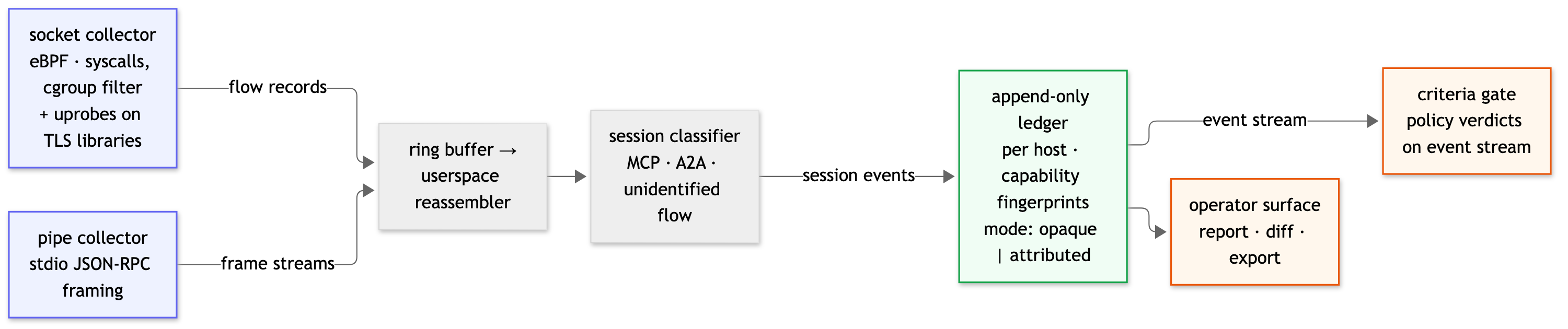
The data path
socket collector (eBPF) ─┐
TLS-boundary collector ──┼─→ ring buffer → reassembler → classifier → ledger ──→ gate stream
pipe collector (stdio) ──┘                                        └──→ report · diff · export
Capture is read-only: no interception, no termination, no path change. Capture loss degrades the ledger; the path is never affected.
Placement
One binary, two placement modes, one event schema.
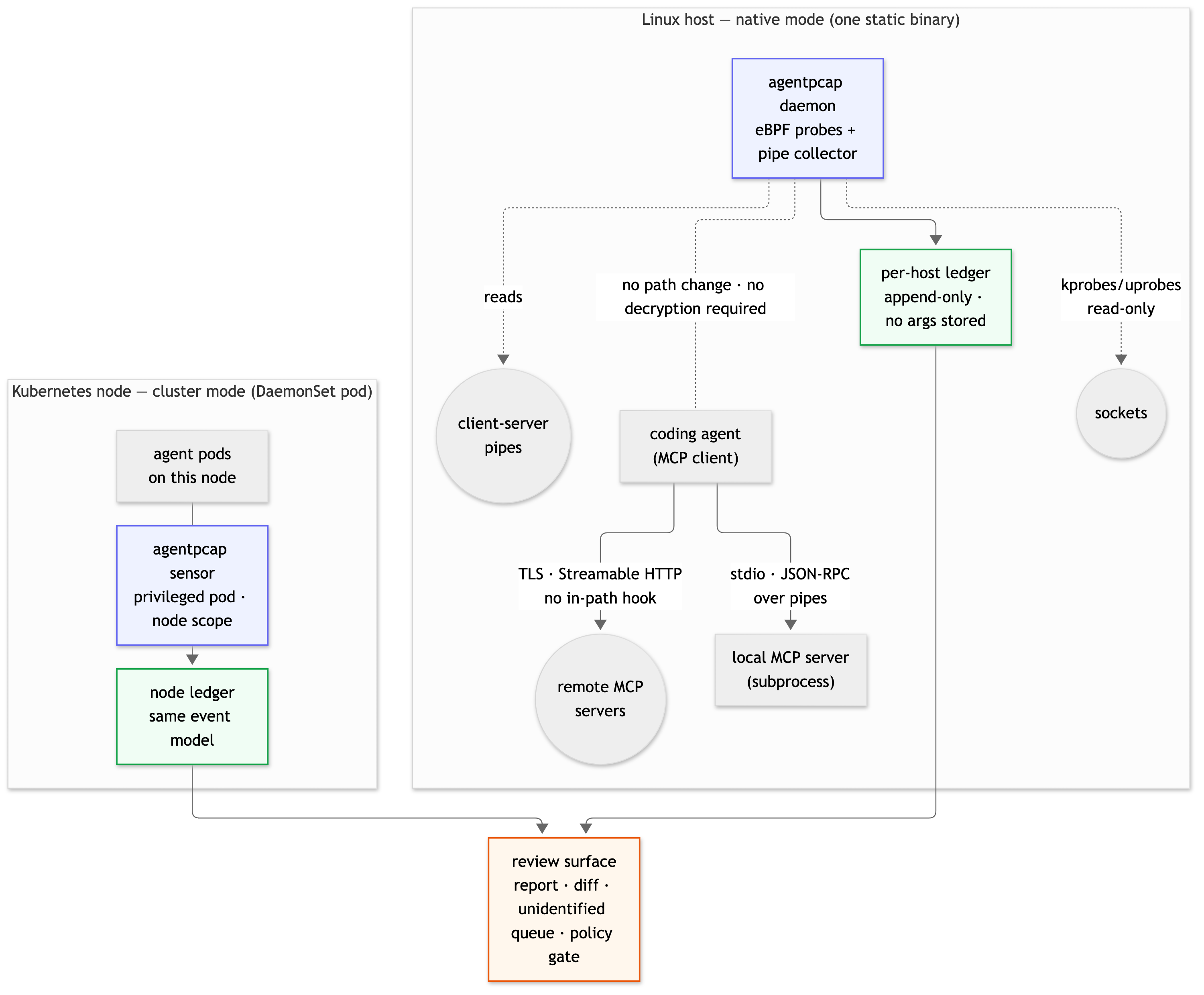
- Host-native: a systemd or launchd service with a bounded eBPF capability set and a per-host ledger at a versioned path.
- Cluster-native: the identical binary per node as a Kubernetes DaemonSet; the node ledger carries the same schema; cluster review aggregates node ledgers.
The flow ledger
JSON Lines, append-only, hash-chained (prev field), access-logged. Tool names and capability fingerprints are stored; arguments and payloads are not. Rotation preserves the prefix; no index is built. Capability drift between sessions — the rug-pull pattern scanners check once — becomes a query at drift time.
Modes
Opaque mode is the default and requires no TLS termination: evidence comes from transport features, pre-encryption headers, DNS and SNI, and pipe plaintext. Attributed mode is opt-in per host boundary through uprobes on the host’s own TLS libraries. Every event records the mode that produced it.
The full normative text is the specification.